:
- The Aung San-Attlee Agreement.
- The Panglong Agreement.
- The Frontier Areas Commission of Enquiry.
- The Provisional Cabinet of Bogyoke Aung San.
- The Provisional Cabinet of Thakin Nu.
- The Authors of the Constitution of the Union of Burma.
- The Nu-Attlee Agreement.
The Aung San-Attlee Agreement paved the way for the Burmans and the Frontier peoples for free intercourse and for frontier leaders to become the Governor’s executive councellors. The Panglong Conference sealed the fate of the future of the Frontier peoples as well as the people of ministerial Burma. They decided to fight together for the independence of Burma. The Frontier Areas Commission of Enquiry composed) of – the leaders of the Frontier Areas who had been elected as Counsellors to the Governor of Burma to represent their respective races viz the Shans, Chins and the Kachins. For the first time in the history of Burma three Frontier leaders elected by their own race sat as Members of the Executive Council of the Government of Burma. The names of the three frontier elected leaders were the Hon’ble Sao Sam Htun Counsellor for Shans; Hon’ble Vum Ko Hau Counsellor for Chins and Hon’ble Sinwa Naw Counsellor for Kachins. They took office in March 1947. They led their delegations earlier to the Panglong Conference where they were instrumental in the successful drafting of the Panglong Agreement. The drafters of the Panglong Agreement and other outstanding frontier leaders were :
Authors of the Panglong Agreement.
- Sao Shwe Thaike, later President of the Union.
- Sao Sam Htun, later Counsellor for Shans.
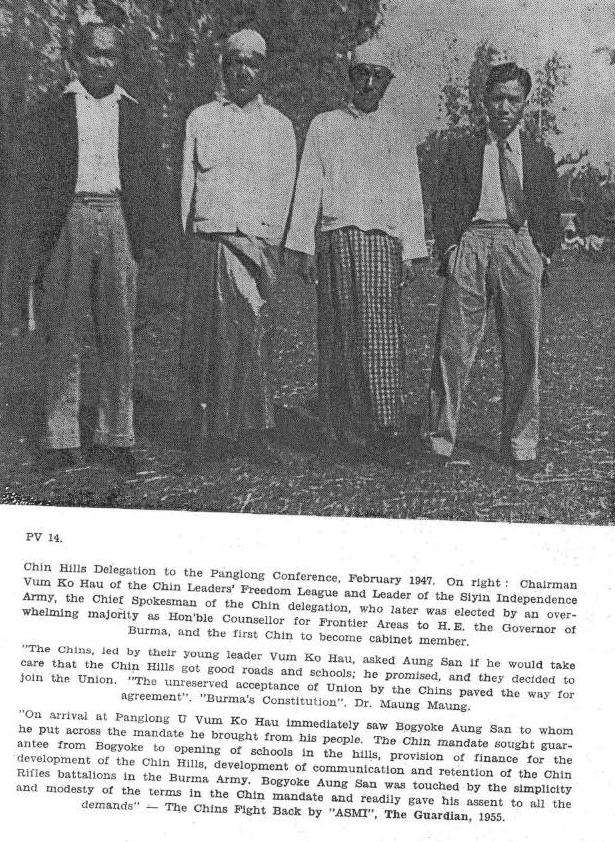
- Vum Ko Hau, later Counsellor for Chins.
- Duwa’ ZaU Lawn, later a State Minister.
- Duwa Sinwa Naw, later Counsellor for Kachins.
- On the Burmese side Bogyoke Aung San was advised by U Tin Tut.
But the drafting of the Agreement was left to the Frontier leaders. The drafting of the historic document took two days as it had to be amended three times as the first two drafts which included a clause stipulating immediate statehood for the three frontier races — the Shans, the Chins and the Kachins was not acceptable to Bogyoke Aung San. On the last day of the conference the Chin leader Vum Ko Hau told his opposite numbers that since Bogyoke Aung San had promised all other things that he had asked for his people, he was-prepared to postpone demand for immediate, statehood for the Chins for decision at the Constituent Assembly. This decision paved the way for further modification of the Agreement to be signed before the end of the conference.
On the successful conclusion of the historic Panglong Agreement uniting the Frontier Areas and ministerial Burma for the first time in the history, the respective Leaders and Chief Spokesmen of the four Delegations were asked to speak at the celebration Banquet. The Speakers at the Banquet on the 12th February 1947 (since gazetted as Union Day) were U Aung San on behalf of ministerial Burma, Vum Ko Hau on behalf of the Chins, Duwa Zau Lawn on behalf of the Kachins and Sao Shwe Thaike on behalf of the Shans.
Dr. Maung Maung, LLD. sums up the Panglong Conference in, “Burma’s Constitution”, as follows:
“The Panglong Conference attended by Aung San and AFPFL leaders, all the Saophas of the Shan States, and leaders of the Chins and the Kachins and representatives of the SCOUHP started early in February and reached agreement on February 12, celebrated today as Union Day and a national holiday to commemorate the coming together of the peoples. It was a unique occasion. The Kachins asked for an autonomous state within the Union, and the issue was debated hard and long, for the Kachins only had their snow-capped mountains which would be inadequate resources for a separate state. The Chins, led by their young leader Vum Ko Hau, asked Aung San if he would, take care that the Chin Hills got good roads and schools; he promised, and they decided to join the Union not even bothering for’ a separate State. The unreserved acceptance of Union by the Chins paved the way for agreement. The Shan saophas threw in their lot, and the Kachins who were promised that the question of demarcating and, establishing a separate Kachin State within a Unified Burma’ would be studied with consideration”.
The author of the “Union of Burma” H. Thinker records : “The Shans were led by Sao Shwe Thaik, Sawbwa of Yawnghwe, and the Sawbwa of Mongpawn. The most prominent Kachin leader was the Sama Duwa Sinwa Nawng of Myitkyina, who had worked for the Japanese. The Chins were represented by Vum Ko Hau, a former leader of the Allied Chin Levies.
Bogyoke Aung San’s personality then was such that his word was sufficient as far as ministerial Burma was concerned and his success in winning the confidence of the three vital Frontier Counsellors helped in no small measure in the deliberations with the Frontier leaders. This was important because it was then the aim of the newly created Frontier Area’s Administration to divide the whole Frontier Areas which includes the Chin Hills, Kachin Hills, Shan States and the Karenni and Pyapon district from those, of the ministerial Burma and attempt to form a separate state should ministerial Burma opt to severe herself away from Britain. Since the Frontier Areas form nearly half (47%) of the total area of Burma and compose of all the adjacent boundaries of Burma with China, India, Pakistan, Laos and Thailand, the decision of the three frontier leaders was vital during the crucial pre-independence period. Hence every thing the three persons said OK decided .was awaited with great interest in those days. When a sovereign independent state of the Union of Burma was achieved in fact, the three Frontier leaders together with Bogyoke Aung San who thus held the reins to the formation of the union of the Frontier Areas with ministerial Bur-ma became the Four senior Founding Fathers of the Union of Burma. From the Panglong days and from the time the frontier leaders joined Aung San’s provisional cabinet the work of the executive council was naturally connected with the all important question of ways and means to get independence for Burma with the inclusion of the whole frontier areas.
On the, fourteenth anniversary of the Union Day the Prime Minister acknowledged the importance of the historic resolutions of the1 Frontier leaders with Bogyoke Aung San at the Panglong Conference:
“Then the Second World War came to Burma. The rulers changed. J n 1945 the ruling fascist enemies were resisted and expelled by Bogyoke Aung San, leaders and comrades. In the resistance movement the peoples of the hills and those of the plains were once again united. With that unity we were able to overcome the enemy of the peoples. Then did we come to learn the value of our unity and of our joint action. Then did we come to learn that we were one in good and ill. After the resistance .movement and the end of the Second World War Bogyoke Aung San continued to endeavour for the independence of Burma. He believed that just as the unity of the indigenous peoples had brought victory in. the resistance movement so
also victory in the struggle for independence could be brought about by such a unity. Accordingly, Bogyoke Aung. San continued to work for the unity of the peoples.
 On February 12, 1947, Bogyoke Aung San and leaders of the indigenous peoples met in conference at Pinlon. Leaders from the hills and the plains and their peoples resolved at the Pinion Conference to win together independence for Burma. They’ also resolved to establish after independence the Union of Burma to assure fair shares of all rights and privileges to all the people. Leaders from the hills and plains so endeavoured in pursuance of the resolution that they won independence for Burma in 1948. Simultaneously the Union of Burma as we see it now was formed with Constituent States and Special Division. In this manner we have come to observe February 12 as Union Day in order to commemorate that day in 1947 when the peoples resolved in concord and unity to establish a Union of Burma, a day that is valued and cherished. Again it may be said that we have come to observe this day because we value and cherish the unity and concord of the indigenous peoples of Burma. I submit this answer to my blood relations on how the Union Day came to be established”.—>page 3


